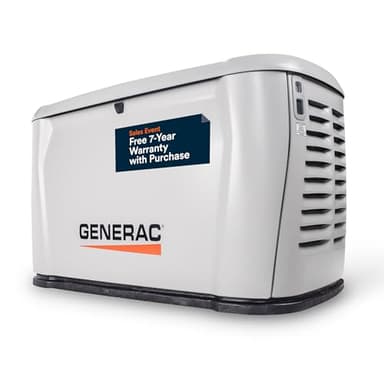
Whole home, 10-second automatic transfer, runs on the gas line indefinitely, monitored from your phone. Budget the install honestly ($10K+ all-in) and outages simply stop being events.
Read full review
~$6,875 typical price
Buy on AmazonUse-case guide · 2026
'I want the whole house to just work' has two honest answers: an automatic standby generator (the complete solution, at a complete-solution price) or a big portable with a 50A connection (most of the capability at a third of the cost, with you as the starting mechanism). Here's how to choose between them.
Running watts
10,000–24,000W depending on home size and AC
Starting surge
Central AC compressor start is the defining surge
Adding more appliances? Run your full load through the sizing calculator →
Whole home, 10-second automatic transfer, runs on the gas line indefinitely, monitored from your phone. Budget the install honestly ($10K+ all-in) and outages simply stop being events.
~$6,875 typical price
Buy on Amazon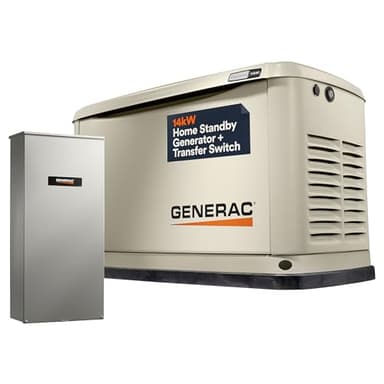
With load management it covers everything a typical home notices — including one AC — for thousands less installed. The best automatic-backup value for most houses.
~$5,399 typical price
Buy on Amazon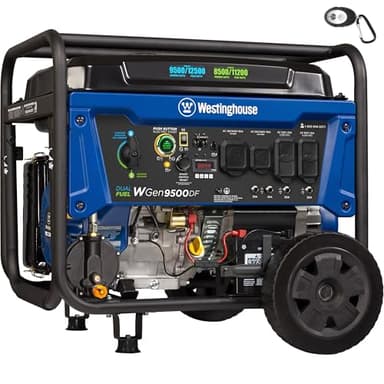
Paired with a 50A HomeLink transfer switch, it feeds your whole panel (you manage the big loads) for under $2,000 total — 80% of the standby experience at 20% of the price, if you're home to start it.
~$1,049 typical price
Buy on Amazon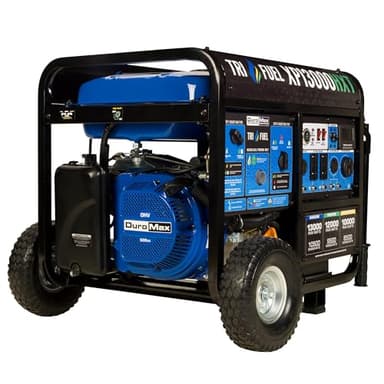
Hooked to your natural gas line via a plumber-installed quick-connect, it runs as long as the outage does — the standby generator's killer feature, minus the $10K install. Remote start from the porch; you still flip the transfer switch.
~$1,499 typical price
Buy on AmazonStandby if outages are frequent, multi-day, or happen when nobody's home — and the ~$10K+ installed budget works. Big portable + 50A transfer switch if you're usually home, outages are occasional, and $2,000 sounds better than $10,000.
Most homes with one 3–4 ton AC land at 14–24kW for run-everything capability, or 9,500–12,500W portable class with load management. A proper load calculation — not square footage guesses — should make the call.