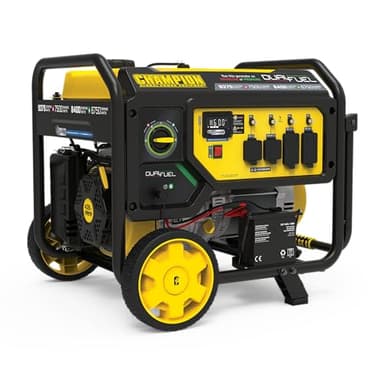
7,500 running watts through its L14-30 outlet starts a 1 HP pump with margin while carrying the furnace and kitchen — the classic well-house pairing with a 30A transfer switch.
Read full review
~$849 typical price
Buy on AmazonUse-case guide · 2026
No power means no water when you're on a well — no taps, no toilets, no showers. Well pumps are the most demanding common household load: most are 240-volt motors with starting surges that overwhelm small generators, so this is the page where wattage math really matters.
Running watts
1,000W (½ HP) to 2,000W (1 HP) — larger pumps more
Starting surge
2,100–4,000W+ (motor start, often 2–3× running)
Adding more appliances? Run your full load through the sizing calculator →
7,500 running watts through its L14-30 outlet starts a 1 HP pump with margin while carrying the furnace and kitchen — the classic well-house pairing with a 30A transfer switch.
~$849 typical price
Buy on Amazon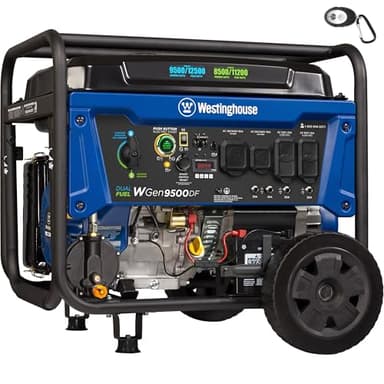
The 50A outlet and 12,500 peak watts shrug off 1.5–2 HP pumps and deep-well surges that strain smaller machines, and remote start matters when the pump house is across the yard.
~$1,049 typical price
Buy on Amazon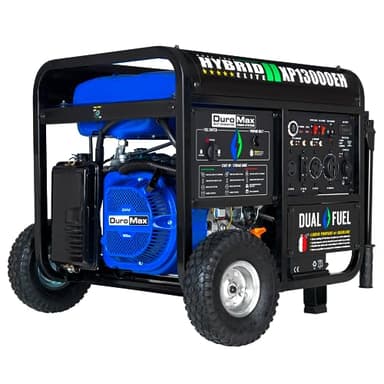
If your load calc stacks a big pump on top of central AC and a large house, the 13,000-peak DuroMax is the portable that still has room left.
~$1,399 typical price
Buy on AmazonYes, if the generator has a 240V outlet and enough surge capacity for the pump's start (typically 2–3× its running watts), connected through a properly installed transfer switch. A 7,500W-class generator handles most 1 HP residential pumps.
Two likely reasons: the pump's starting surge exceeds the generator's peak rating, or the generator lacks 240V output entirely. Most 3,500W units are 120V-only — check for an L14-30 outlet.