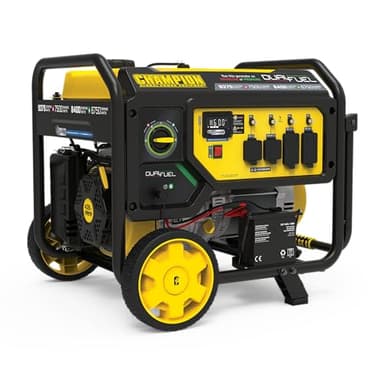
7,500 running watts feeds a compressor, saws, and battery chargers simultaneously, dual fuel means propane on remote sites with no gas station, and Champion parts are stocked everywhere trades shop.
Read full review
~$849 typical price
Buy on AmazonUse-case guide · 2026
Job-site power is about surge, not average: a circular saw idles at nothing and demands 2,300W the instant the trigger pulls, and compressors are worse. The right site generator starts the grumpiest motor on the truck without browning out everyone else's tools.
Running watts
1,400–2,000W per big corded tool; 4,000–7,500W for a working crew
Starting surge
Compressors and saws surge 2–3× running draw
Adding more appliances? Run your full load through the sizing calculator →
7,500 running watts feeds a compressor, saws, and battery chargers simultaneously, dual fuel means propane on remote sites with no gas station, and Champion parts are stocked everywhere trades shop.
~$849 typical price
Buy on Amazon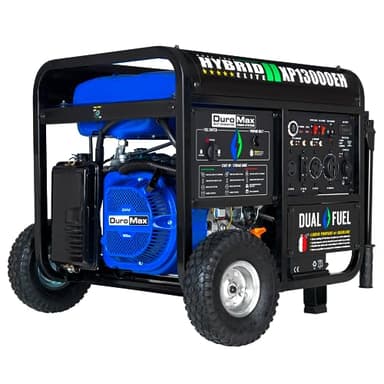
The MX2 mode pushes full amperage to 120V tools, and 13,000 peak watts absorbs compressor-plus-saw surges that trip smaller units. Welder-adjacent duty wants this class.
~$1,399 typical price
Buy on Amazon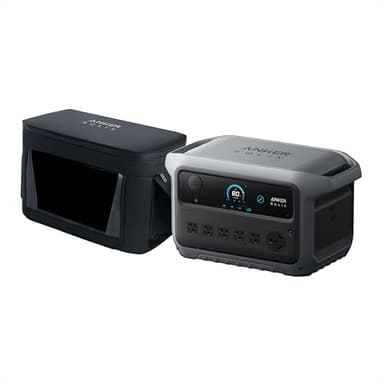
For cordless-tool crews, a 2kWh station charges packs all day in silence — no fuel runs, no exhaust in enclosed spaces, allowed on noise-restricted and indoor sites.
~$1,099 typical price
Buy on AmazonA typical pancake compressor surges ~3,000W and a circular saw ~2,300W. To absorb both (never intentionally simultaneous, but Murphy's law) plus chargers and lights, the 7,500W class is the safe answer.
OSHA requires GFCI protection for receptacle circuits on construction sites. Many contractor-oriented generators include GFCI-protected 120V outlets — otherwise use inline GFCI adapters.